Why the Ultra-i2 Is the Best-Selling Offline Selective Soldering Machine
A technical analysis of why the Sasinno Ultra-i2 has become the most popular offline selective soldering machine: large work envelope, full-standard preheating, dual independent solder pots, and unique options that are rarely found elsewhere on the market.
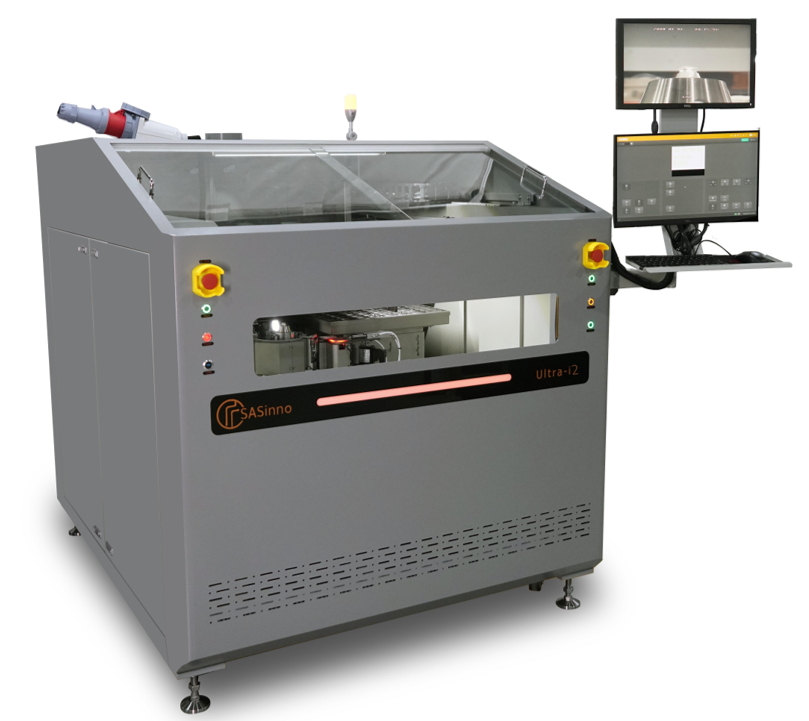
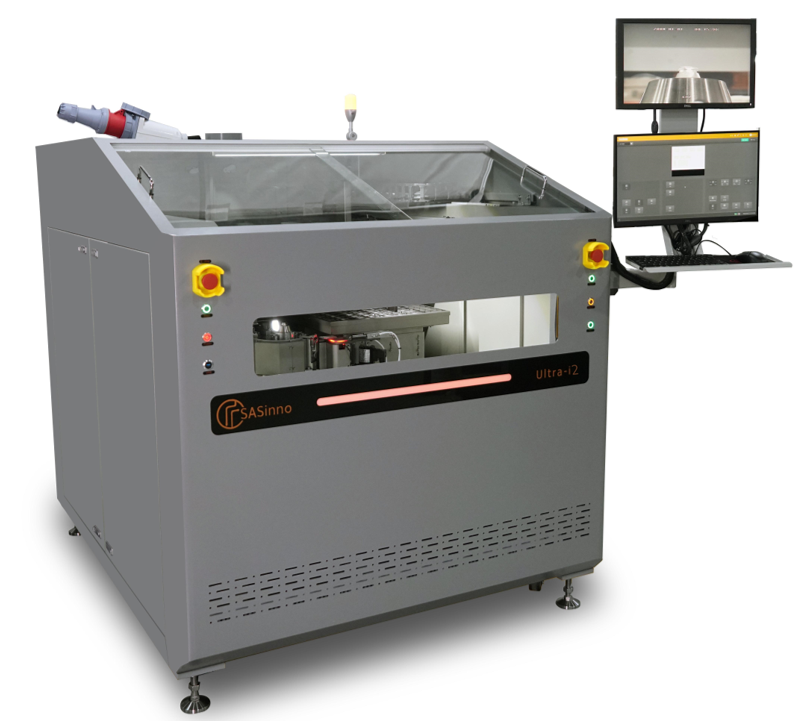
Sasinno Ultra-i2 — offline selective soldering platform (front view).
Introduction
Among offline selective soldering machines, the Sasinno Ultra-i2 has become one of the most frequently selected — and best-selling — platforms in its category. That popularity is not the result of marketing. It is the result of a set of engineering decisions that give the machine a combination of work envelope, standard process capability, and flexibility that no other offline selective soldering system currently offers at the same level.
This article breaks down the technical reasons, point by point.
1. A Work Envelope That Covers Over 90% of Offline Applications
The standard Ultra-i2 configuration processes PCBs up to 460 × 510 mm (approx. 18" × 20"). Within the category of offline machines, this is an exceptionally large processing area — large enough to cover more than 90% of typical offline selective soldering requirements in the market.
For customers with even larger assemblies, an optional extended configuration supports boards up to 24" × 24" (610 × 610 mm).
2. Standard Equipment That Competitors Offer as Options — or Cannot Offer at All
The Ultra-i2's standard technical configuration includes:
· Two drop-jet fluxers (high-precision flux application)
· Top AND bottom preheating modules — both standard
· Two electromagnetic solder pumps with inherently low maintenance requirements
· Two inline N₂ heaters for nitrogen atmosphere optimization
· Automatic wave height calibration
· Servo-driven motion control on all axes
In comparable offline machines on the market, this level of equipment is essentially absent as standard. Most competing offline selective soldering systems offer no preheating at all: bottom preheating is generally not available, and top preheating is typically offered only as a paid option — or is not technically achievable at all. The Ultra-i2 delivers all of it as standard equipment.
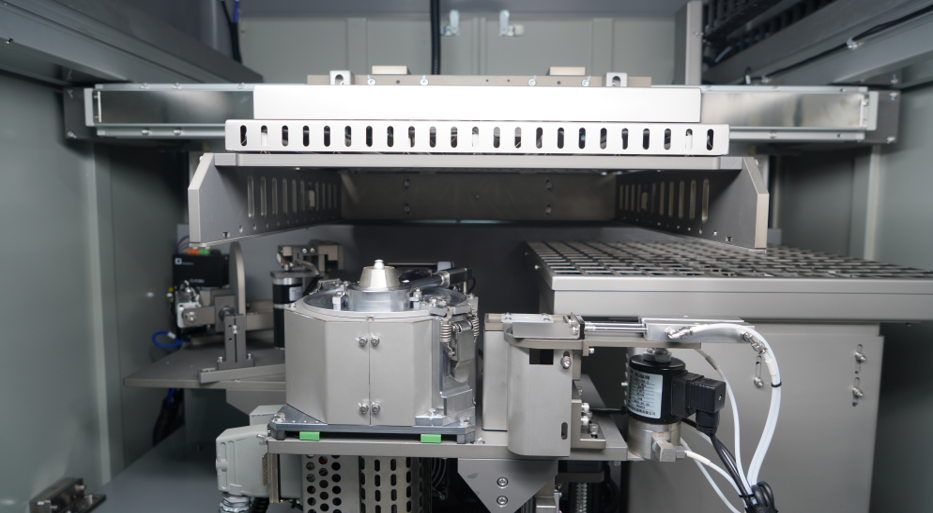
Internal view — top + bottom preheating modules and dual solder pot assembly.
3. Why Preheating Matters — and Debunking a Common Misconception
Some machines on the market tell customers that preheating can be performed using the nitrogen that protects the solder nozzle. In practice, this approach only heats a single localized point, and its efficiency is very low. If a PCB carries 100 solder joints and the process must dwell at each location to accumulate heat, the resulting cycle-time loss is enormous.
The reality behind this claim is simple: these manufacturers do not implement bottom preheating — or cannot technically achieve it — so the market is sold a misleading concept.
Proper preheating is critical to solder joint quality, especially on PCBs with significant thickness. Consider a 2 mm-thick board: the entire thickness of the laminate, from the top surface to the inner layers, must reach the required temperature before soldering. This thorough, full-thickness thermal preparation is the essential precondition for the molten solder to wet and penetrate the through-hole to the 75% fill level expected by industry workmanship standards.
Without real preheating, that penetration standard is left to chance. With top and bottom preheating as standard process steps, the Ultra-i2 makes it repeatable.
4. Two Independent Solder Pots: Flexibility No Single-Pot Machine Can Match
The Ultra-i2 carries two completely independent solder pots, each with:
· Its own independent Z-axis
· An automatically adjustable pot-to-pot spacing
· Its own electromagnetic pump, with very low maintenance demand
All of this is standard. This architecture enables several distinct ways of using the machine, which customers select according to their own production conditions.
4.1 Lead-Free and Leaded, Side by Side
One pot can run leaded solder while the other runs lead-free — and because the machine also has two independent drop-jet fluxers, the leaded and lead-free processes can use different flux chemistries simultaneously.
For small-batch, high-mix manufacturers, process changeover becomes dramatically simpler: while one pot is running a leaded job, the second pot can already be on standby for the lead-free job. Switching from one to the other is a matter of loading the other program — a seamless transition.
On a typical single-pot machine, the same changeover means: pulling the solder pot out, installing the alternate pot, and waiting for the solder to fully melt again. Between pot exchange and re-melting, one to two hours of production are lost — every time.
4.2 Doubling Throughput on Single-Alloy Production
If the customer runs only one solder alloy — all leaded or all lead-free — and board sizes are moderate while volumes are high, the machine can be set up so that two boards are placed in a single fixture and soldered simultaneously, one over each pot.
Throughput doubles, with no additional machine.
4.3 Large Nozzle + Small Nozzle: One Machine for Mixed Joints
Large boards often carry a mixture of joint types: high-thermal-mass points such as ground connections and connectors, alongside fine single points surrounded closely by other components with little clearance.
The Ultra-i2 can be configured with one large nozzle and one small nozzle running consecutive operations: the large nozzle solders the high-thermal-mass ground points and connectors first, then the small nozzle handles the joints in tight spaces.
All of these mode changes — alloy switching, dual-board processing, nozzle assignment — are made entirely in software. This is what makes the machine suitable for such a wide range of scenarios and applications.
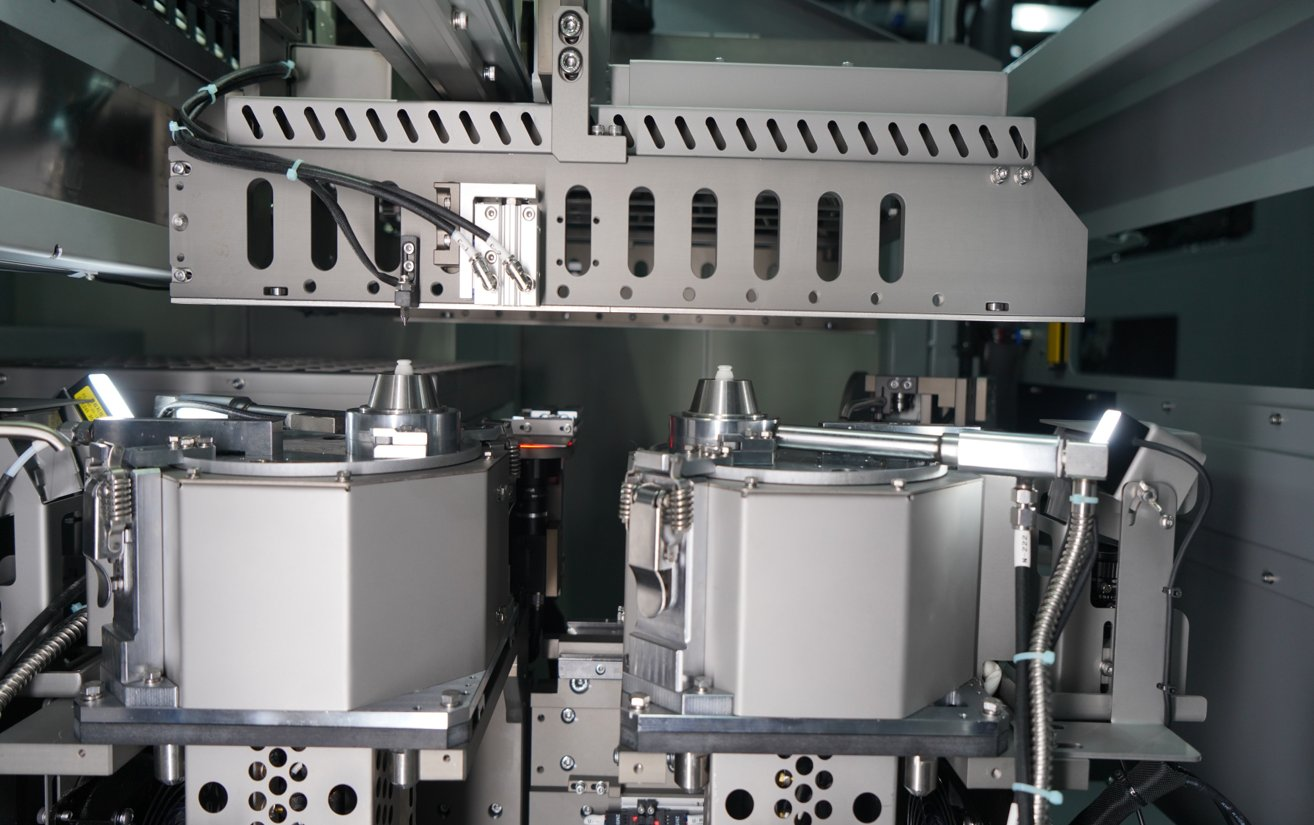
Two independent solder pots with electromagnetic pumps and nozzles.
5. Unique Options
Beyond the standard configuration, the Ultra-i2 offers several options that are genuinely unique in this category.
5.1 Solder Pot Cart: Safe, Hands-Free Pot Maintenance
A full solder pot weighs roughly 20–30 kg and operates at 280–300 °C. The last thing an engineer should do during a major maintenance event is pull that pot out by hand.
The optional solder pot cart docks directly to the machine. Operating like a small forklift, it extracts the pot — the operator never touches the solder pot — and transports it outside the machine for thorough maintenance. The result is a maintenance procedure that is simultaneously safer and more convenient.
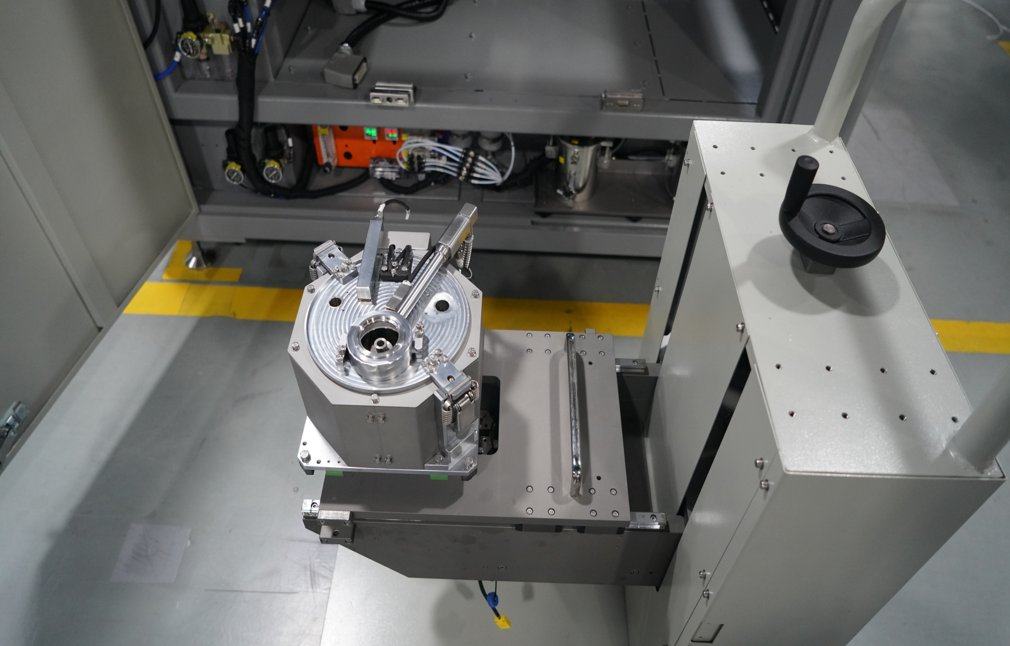
Solder pot cart docking to the machine for hands-free pot handling.
5.2 Laser Height Sensing: Warped and Thin Boards Without Custom Fixtures
Some PCBs are thin, or made of materials that deform easily — but their volumes don't justify investing in a custom correction fixture to mechanically flatten the board.
For these cases, the Ultra-i2 offers optional laser height sensing. The system measures the actual height of every soldering path on the board, and the soldering process automatically compensates for height variation in real time — with very high accuracy. Boards that would otherwise require a custom fixture can be soldered as-is.
5.3 Insertion Station: One Operator, One Workstation
Mounted at the front of the machine, the optional Insertion Station is a bracket carrying two shuttle carts.
The workflow:
1. The operator performs manual insertion work on the left cart.
2. The loaded cart slides to the machine center, and the PCB is pushed into the machine for soldering.
3. The center cart returns left, and the operator begins inserting the next board.
4. When the soldered board is finished, the right cart receives it and moves it to the machine's right side.
Previously, this required two separate machines: a selective soldering machine plus an insertion conveyor or workbench — and an operator running between several locations: inserting components at the insertion conveyor, carrying boards to the selective soldering machine, then removing finished boards to yet another location.
With the Insertion Station, all of these operations happen at one station in front of the machine: insertion, soldering (load/unload), and board removal. The operator stays in one place.
The benefits are twofold: the operator saves time and experiences lower physical strain, and the customer avoids the capital cost of a separate workbench or insertion conveyor.
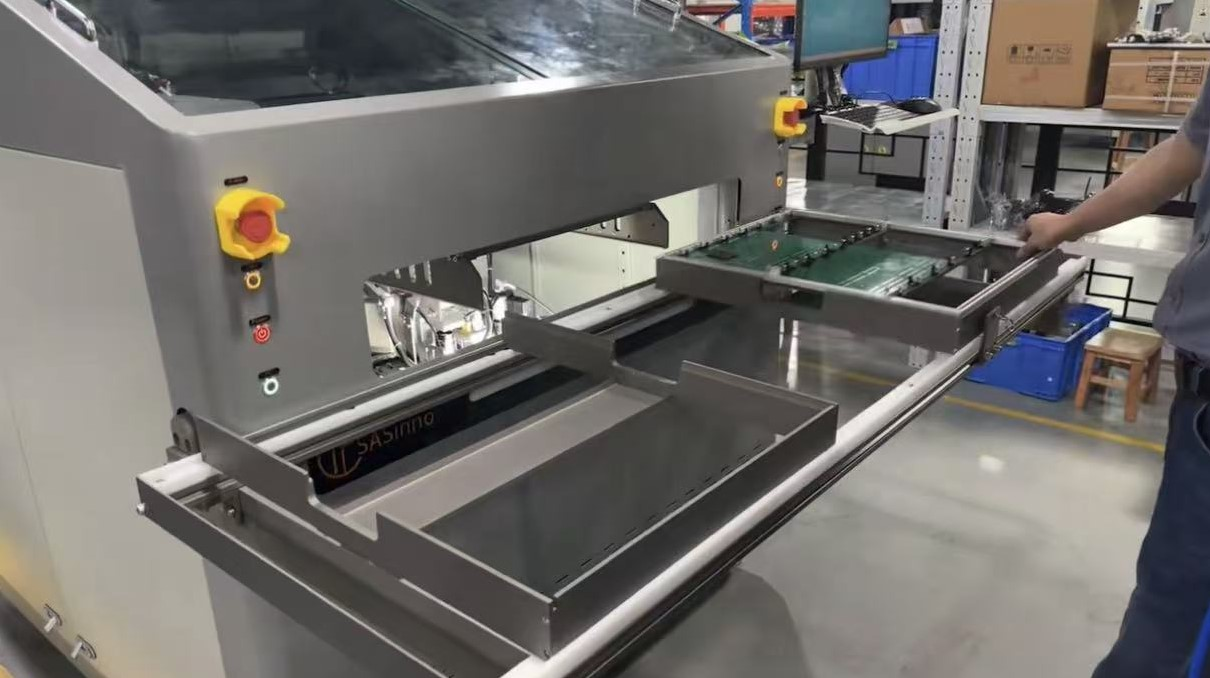
Insertion Station with dual shuttle carts — insertion, soldering, and unloading at one operator position.
6. The Standard Camera: One Piece of Hardware, Four Functions
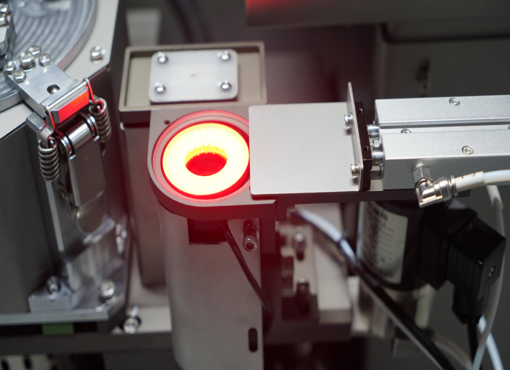
The Ultra-i2 comes standard with a process camera — a single piece of hardware that integrates four functions. This combination is not offered by other machines on the market.
1. Fiducial mark recognition. When the PCB enters the machine, the camera performs visual correction, measuring the board's positional offset inside the machine. That offset is automatically compensated into the soldering paths, ensuring precise solder joint placement.
2. Board scanning. When programming a board for the first time — and no PCB design files or documentation are available — the board is simply placed in the machine and scanned. The camera captures the board field-of-view by field-of-view and stitches the images into a complete PCB picture. Programming then proceeds from that image, which is considerably simpler.
3. Direct teaching. For simpler boards with few solder points, scanning the full board image is unnecessary. The camera simply moves beneath each location, and the operator teaches the software which points require soldering.
4. Program simulation. After the soldering paths are programmed, the camera can walk the entire path in a dry run — moving beneath each programmed location so the engineer can see at a glance whether the programmed paths are correct, before any solder flows.
Conclusion
The Ultra-i2's position as the best-selling machine in its category is earned, not marketed:
· A work envelope covering more than 90% of offline requirements, extendable to 24" × 24"
· Full-standard process equipment — dual fluxers, top and bottom preheating, dual electromagnetic solder pots — where competitors offer options or nothing at all
· Proper thermal preparation that makes the 75% through-hole penetration standard repeatable
· Two independent solder pots enabling seamless leaded/lead-free changeover, doubled throughput, and mixed-nozzle soldering
· Unique options — solder pot cart, laser height sensing, Insertion Station, and the four-function camera — that address real production problems: operator safety, board deformation, and operator efficiency
For customers evaluating offline selective soldering equipment, these are the technical reasons why so many of them end up choosing the Ultra-i2.
Contact Us
To discuss your board requirements, process evaluation, or a sample soldering test, contact your regional Sasinno team:
Sasinno Americas Mike Young, North America Director Washington, MO, USA mike@sasinnoamericas.com · +1 636 888 4811
Sasinno Europe Cengiz Karaca, Europe Director Monschau, Germany cengiz.karaca@sasinno.eu · +49 (0) 2472 912 70 40
Regional service and technical support is also available in China, Latin America (Mexico), and across North America and Europe.